

SHOU SUGI HOUSE
COMPLETED
FUNCTION: Single Family Dwelling
SITE AREA: 786 sqm
FLOOR AREA: 590 sqm
Located along the waterfront of Sentosa Cove, Shou Sugi House reworks an existing residence whose primary structure was retained while its architectural language was comprehensively reconsidered.
The project takes its name from shou sugi ban, the traditional Japanese technique of preserving timber through controlled charring. By transforming the surface of wood into a carbonised layer, the process improves durability and resistance to moisture, insects, and weathering while producing a deep textured black finish. This technique becomes both the conceptual and material foundation of the house.

The sea-facing side of Shou Sugi House
The original building had been designed with a mixture of architectural expressions. Non-structural concrete elements stamped to resemble fair-faced concrete were combined with timber screens and a variety of façade treatments. While individually expressive, these elements lacked coherence as a whole and were poorly suited to the humid coastal environment. The renovation therefore began by removing these superficial layers to reveal the underlying structural framework of the house.

Shou sugi ban cladding made of Accoya timber planks
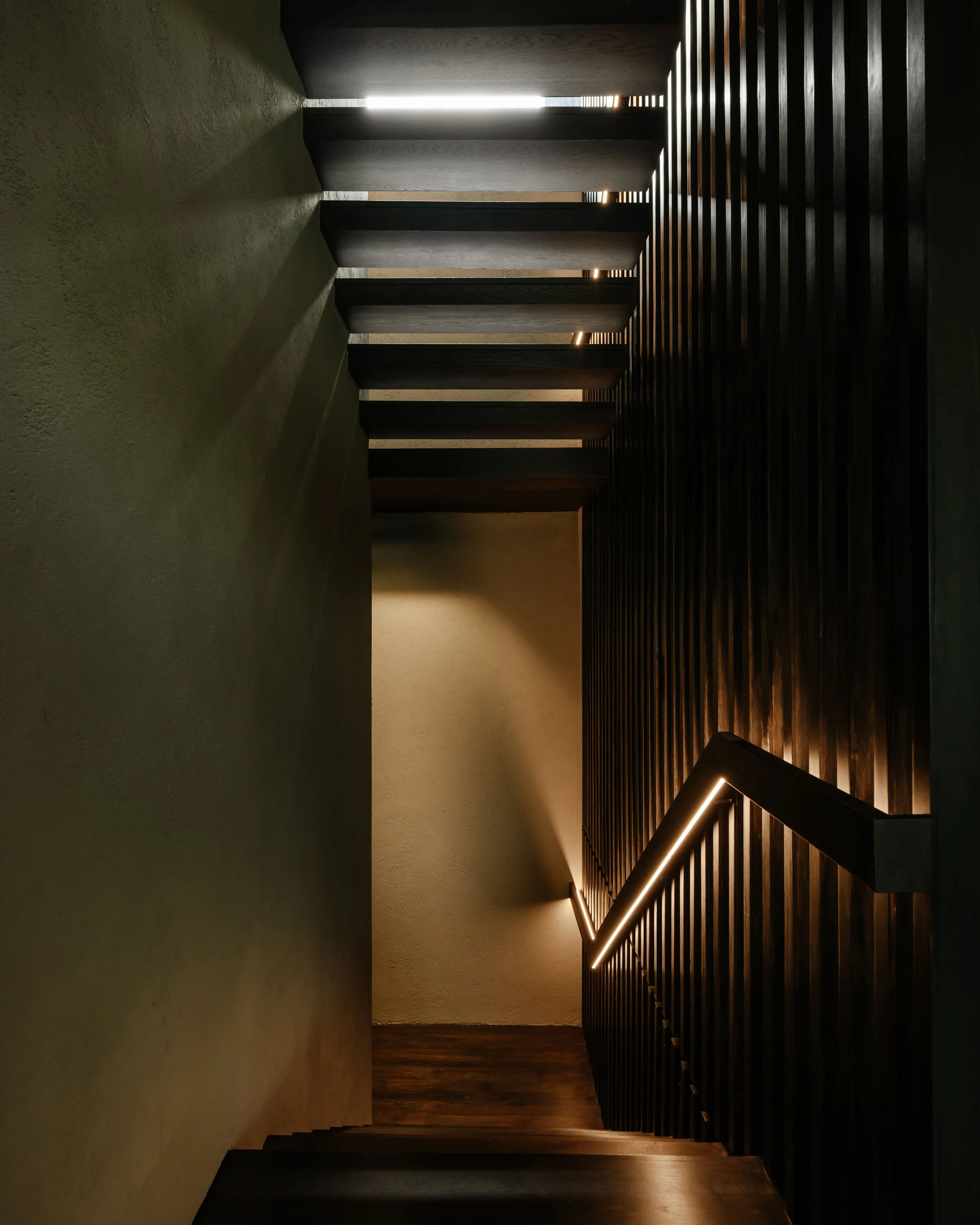
A new architectural order is established through a singular material strategy. The external structural elements are wrapped in shou sugi ban cladding made of charred Accoya timber planks, forming a continuous grid that consolidates the structural frames of the building. Expressed as vertical and horizontal panels woven into a disciplined framework, the cladding establishes a clear rhythm across the façade while allowing windows and terraces to sit deeply recessed within the structural order.
Beyond its visual clarity, the charred timber surface responds directly to the tropical maritime climate of Sentosa Cove. The protective carbonised layer enhances the durability of the timber while allowing the material to age gradually with subtle variation over time.

Outdoor alfresco dining area out towards the waterway.

The living room, facing out to the waterway
The tonal language of the exterior establishes the foundation for the interior spaces. Inside, the house adopts a restrained and largely monochromatic palette composed of dark oak and champaca, pale grigio olivo mineral limestone and muted blue st blaise stone. Structural elements, cabinetry, and openings are carefully aligned so that lines extend continuously across rooms with quiet precision.

Large expanses of glazing open the interior to the surrounding water and landscape. Deep overhangs and horizontal louvers temper the tropical sun, allowing daylight to enter in a controlled manner while casting shifting linear shadows across the interior surfaces.

Master bedroom with connecting spiral staircase leading to the attic lounge.
Within the master suite, a double-volume bedroom faces the waterway, framing expansive views across the landscape. The height of the space allows morning light to enter deeply into the room, gradually illuminating the mineral surfaces and timber finishes. A sculptural spiral stair rises within this volume, connecting the bedroom to a private lounge located within the attic above. The stair forms a continuous curved element within the otherwise disciplined geometry of the house, establishing a vertical spatial sequence between rest, retreat, and outlook.

The spiral staircase connecting the master bedroom to the attic lounge

Close-up of the spiral staircase’s textured finish

The master bathroom connection to the exterior outdoor bath and landscape

Close-up of the shou sugi ban cladding
In the basement, the space is transformed into a dedicated home theatre. The room is lined with customised indigo blue-stained birch veneered panels arranged within a precise grid. Within this system, the geometry is subtly manipulated: each panel is tilted slightly while remaining planar, allowing concealed speakers to be integrated behind the surface. The calibrated angles also form narrow slits between panels that introduce indirect lighting both upwards and downwards. Beyond its visual expression, the tilting of the acoustic panels allows the surfaces to both absorb and disperse sound, creating a carefully balanced acoustic environment. The result is a spatial field of controlled reflections, light and sound that together produce an immersive cinematic experience.

A dedicated home theatre in the basement

The mix of various panels - flat, micro-perforated, concealed indirect lighting
In Shou Sugi House, the Japanese technique becomes more than a material treatment. It establishes a disciplined architectural language that unifies the building, allowing the house to be defined by proportion, alignment, and light rather than competing gestures. The result is a calm and coherent dwelling that sits quietly within its tropical waterfront setting.
Image Gallery


CREDITS
TEAM MEMBERS Pan Yi Cheng, Daniel Chia, Guo Xiu Jin, Darrell Lim, Florian Pacheco Züge
PHOTOGRAPHY Finbarr Fallon
STYLING Out Of Stalk
BUILDER Greenleaf Industries Pte Ltd
C&S CONSULTANT Span Consultants
QUANTITY SURVEYOR Barton Bruce Shaw Pte Ltd
AUDIO & VISUAL AOE Pte Ltd
CARPENTRY EB Craftsmen Pte Ltd, HH Design Pte Ltd, XTRA Designs Pte Ltd
CARPENTRY (MOVIE ROOM) Superstructure SG Pte Ltd
CARPETS Jehan Gallery Pte Ltd
LANDSCAPING Nyee Phoe Flower Garden Pte Ltd
LIGHTS Light Basic Studio Pte Ltd
STONE KStone Pte Ltd
SHOU SUGI BAN Calvary Carpentry Pte Ltd
SMART HOME GIRA, Eureka Technologies Pte Ltd
WINDOWS OTIIMA, Sapphire Windows Pte Ltd